Quick Summary: Kitchen Sink Repair (What Homeowners Should Expect)
Kitchen sink repair often starts with a simple symptom—water under the cabinet, a slow drain, or a faucet drip—but kitchen sink repair usually requires pinpointing the exact failure point in a tight, high-use area. Kitchen sink plumbing includes a faucet, shutoff valves, supply lines, a basket strainer, a tailpiece, a P-trap, and a branch drain line, and any one of those parts can leak or clog. Licensed Prosper, TX plumbing professionals typically begin a service call with a structured inspection, then perform targeted repairs such as replacing a faucet cartridge, resealing a basket strainer, rebuilding a P-trap connection, swapping corroded supply hoses, or clearing a drain blockage with a hand auger or power snake.
Kitchen sink repair appointments commonly take 1–3 hours, depending on access, corrosion, and part availability. Kitchen sink repair costs vary based on diagnostic time, fixture complexity, and whether replacement parts are needed. Water pooling under a kitchen sink cabinet, sewer odors, repeated clogs, or water backing up into a second fixture often signals a problem that requires a professional plumber in Prosper or Celina, TX. Specialty Plumbing provides clear explanations, upfront options, and code-aware repairs from a locally owned, full-service team.
Kitchen Sink Repair Basics: What Kitchen Sink Repair Refers To (and Why Problems Escalate Fast)
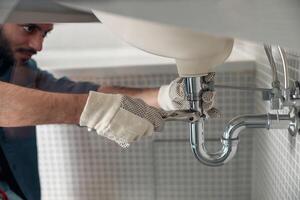
Kitchen sink repair is the process of restoring proper water delivery and drainage at the kitchen sink by fixing leaks, clearing obstructions, and replacing failed components. Kitchen sink systems fail frequently because kitchen sinks combine pressurized water (supply side) with gravity drainage (drain side) inside a cabinet that traps moisture and hides small drips.
Kitchen sink repair matters because a “minor” leak can cause expensive secondary damage. Cabinet base swelling can start after repeated wetting, and mold growth risk increases when damp wood stays wet for 24–48 hours in warm conditions. Water damage around a sink can also loosen faucet mounting hardware and accelerate corrosion on metal fittings.
Common Parts Involved in Kitchen Sink Repair
Kitchen sink repair often involves one or more of the following components:
- Angle stop shutoff valves (hot and cold) at the wall
- Flexible supply lines (commonly braided stainless steel) from valve to faucet
- Faucet cartridge or ceramic disc valve (brand-specific parts for Delta, Moen, Kohler, Pfister, and others)
- Basket strainer and locknut at the sink drain opening
- Tailpiece, slip-joint nuts, and beveled washers under the strainer
- P-trap (PVC, ABS, or metal) that holds a water seal to block sewer gas
- Dishwasher drain hose connection (often tied into the disposal or a branch tailpiece)
- Garbage disposal and disposal discharge tube (if installed)
Kitchen Sink Repair Warning Signs: Symptoms That Point to Specific Problems
Kitchen sink repair becomes easier and cheaper when homeowners catch early warning signs. Kitchen sink problems usually show up as leaks, drainage changes, odors, or abnormal sounds.
Leak and Moisture Warning Signs
- Water pooling under the sink cabinet after faucet use often indicates a drain-side leak at a slip joint, P-trap, basket strainer, or disposal connection.
- Water droplets on supply hoses often indicate a loose compression nut, a failing rubber gasket, or a pinhole leak in a braided line.
- Green-blue staining on copper often indicates a slow leak and copper oxidation around a fitting.
- Rust on metal trap parts often indicates long-term moisture and imminent failure of thin-wall tubular metal.
Drainage and Clog Warning Signs
- Slow draining often indicates grease buildup, food debris, or a partial blockage in the trap arm or branch line.
- Gurgling sounds during draining often indicate venting issues, partial blockages, or negative pressure pulling water from the trap.
- Recurring clogs every 1–2 weeks often indicate a deeper blockage beyond the P-trap or an undersized/incorrect drain configuration.
Odor and Backup Warning Signs
- Sewer gas odor near the sink often indicates a dry trap, siphoned trap, or leak that breaks the water seal.
- Water backing up into a second fixture (such as a laundry standpipe or bathtub) often indicates a larger drain line issue that can require professional drain cleaning.
Kitchen Sink Repair: What Happens During a Professional Visit in Prosper, TX
Kitchen sink repair by a licensed plumber follows a repeatable process designed to prevent repeat leaks and protect cabinets and flooring. Specialty Plumbing uses a diagnose-first approach because the “obvious leak” frequently masks a different failure point.
Confirm the symptom and isolate the system
A plumber confirms the complaint by running hot and cold water, operating the sprayer, and cycling the garbage disposal (if installed). A plumber isolates the system by locating the hot and cold shutoff valves and confirming valve function.
Inspect the under-sink assembly for the real leak path
A plumber inspects the faucet shank, sprayer hose loop, supply line connections, angle stops, basket strainer locknut, tailpiece joints, P-trap joints, disposal discharge tube, and dishwasher drain tie-in. A plumber often uses a flashlight and inspection mirror to track water trails along pipes and cabinet walls.
Diagnose the failure mode (seal failure vs. crack vs. blockage)
A plumber distinguishes between a failed gasket/O-ring, a cross-threaded slip nut, a cracked plastic fitting, corrosion pinholes, or a loose mounting surface. A plumber also checks for cabinet swelling and prior DIY sealants that can hide cracks.
Perform the repair with the correct materials
A plumber replaces washers, beveled slip-joint seals, cartridges, supply lines, or corroded tubular sections as needed. A plumber uses PTFE tape on appropriate metal threaded connections and avoids incorrect sealants on slip joints that require compression washers.
Test under real operating conditions
A plumber tests repairs by running water for several minutes, filling and draining the sink, and checking every joint with a dry paper towel. A plumber verifies proper drainage, confirms no drips during sprayer use, and checks disposal discharge joints for seepage.
Document findings and prevention tips
A plumber explains the root cause, shows the failed part when possible, and provides prevention guidance tailored to the kitchen setup.
Typical Tools a Professional Uses (and Why Tools Matter)
Kitchen sink repair often requires specialty tools because the work area is cramped:
- Basin wrench for faucet mounting nuts in tight spaces
- Channel-lock pliers for slip nuts and trap adjustments
- Spud wrench or strainer wrench for basket strainers
- Hand auger (drain snake) for localized clogs
- Power snake for deeper branch line blockages
- Inspection mirror and headlamp for hidden drips behind the sink bowl
Common Kitchen Sink Repair Scenarios (and the Correct Fix)
Kitchen sink repair usually falls into a few repeatable categories. Correct repair selection prevents repeat service calls.
Kitchen Sink Drain Leak Repair (P-trap, tailpiece, slip joints)
Kitchen sink drain leaks commonly come from misaligned slip-joint washers, overtightened plastic nuts, or cracked tubular parts. Kitchen sink drain repair often includes disassembly, cleaning mating surfaces, replacing beveled washers, and re-aligning the trap arm to remove stress.
DIY-safe check: Hand-tightening a slip nut plus a small additional turn can stop a minor seep. Pro-level fix: Replacement of cracked tubular sections or reconfiguration of an incorrect trap setup prevents recurring leaks.
Kitchen Faucet Repair (Drips, low flow, loose faucet base)
Kitchen faucet drips often come from a worn cartridge, degraded O-rings, or mineral buildup. Kitchen faucet low flow can also come from a clogged aerator or debris in the cartridge after water work.
DIY-safe check: Aerator cleaning and debris flush can restore flow. Pro-level fix: Brand-specific cartridge replacement on Moen or Delta faucets often requires correct part matching and careful reassembly to prevent cross-threading and leaks.
Clogged Kitchen Sink Drain (Grease, food waste, sludge)
Clogged kitchen sink drains often involve grease and food particles that stick to pipe walls. Clogged drain repair often requires a mechanical clearing method because chemical drain cleaners can damage seals and leave caustic liquid in the trap.
DIY-safe check: P-trap cleaning can remove localized debris. Pro-level fix: Snaking beyond the trap arm addresses deeper blockages that cause recurring slow drains.
Garbage Disposal-Related Leaks and Drainage Problems
Garbage disposal leaks can come from the sink flange seal, the discharge tube gasket, or internal disposal failure. Garbage disposal drainage issues can also come from a blocked disposal chamber or an incorrectly routed dishwasher drain hose.
DIY-safe check: Reset button use and jam clearing with a hex key (if manufacturer-approved) can restore function. Pro-level fix: Disposal replacement becomes the best approach when internal seals fail or the motor housing leaks.
For disposal-specific troubleshooting, see How to Troubleshoot and Fix a Broken Garbage Disposal in Prosper, TX.
Troubleshooting Map: Symptom → Likely Cause → Safe Next Step
Kitchen sink repair decisions become easier with a quick mapping guide.
| Symptom | Likely Cause | Safe Next Step |
|---|---|---|
| Water dripping below sink | Loose slip nut, worn washer, cracked trap | Dry area, run water, dab joints with a paper towel to locate leak |
| Slow draining sink | Clogged P-trap, grease buildup, partial branch clog | Try plunger; clean P-trap if comfortable; stop if corrosion appears |
| Faucet drips constantly | Worn cartridge, worn seal | Identify faucet brand; avoid overtightening handles; plan cartridge replacement |
| Water spraying at supply hose | Split hose, loose connection | Shut off angle stops; replace supply line rather than patching |
| Bad odor from drain | Organic buildup, dry trap, venting issue | Clean trap and run water; call a plumber if sewer odor persists |
| Water backing up into dishwasher or second sink bowl | Shared drain restriction | Stop using sink and dishwasher; schedule professional drain clearing |
Safe DIY Kitchen Sink Repair Steps (and When DIY Should Stop)
Kitchen sink repair DIY work can be safe for minor adjustments and basic cleaning. Kitchen sink repair DIY work becomes risky when corrosion, stuck fittings, or hidden leaks appear.
Dry every surface under the sink
A homeowner dries supply lines, shutoff valves, trap joints, and the cabinet floor with a towel to remove old water.
Run water in distinct modes
A homeowner runs cold water for 60 seconds, then hot water for 60 seconds, then sprayer use for 30 seconds, then a full sink drain cycle.
Dab each joint with a dry paper towel
A homeowner presses a paper towel against each connection to identify the first wet point.
Stop at corrosion or cracks
A homeowner stops DIY work when green-blue corrosion, rust flakes, or cracked plastic appears because tightening can break fittings.
Prepare the workspace
A homeowner places a shallow pan under the trap and removes items from the cabinet.
Loosen slip nuts carefully
A homeowner loosens slip nuts by hand first and uses pliers only when necessary to avoid cracking plastic.
Remove debris and rinse parts
A homeowner removes sludge and food debris and rinses the trap with warm water.
Reassemble with correct alignment
A homeowner seats beveled washers correctly and aligns pipes without forcing the trap arm.
Test for leaks
A homeowner runs water for several minutes and checks every joint with a paper towel.
Kitchen Sink Repair Cost Factors in Prosper, TX (Pricing Transparency Without Surprises)
Kitchen sink repair pricing varies based on labor time, part requirements, and complexity. Many professionals charge a diagnostic or service call fee, and many plumbing companies apply that fee toward completed repairs.
Cost Drivers That Change the Final Total
- Access limitations: Tight cabinets, deep farmhouse sinks, and pull-out trash systems add labor time.
- Garbage disposal presence: Disposal removal and reinstallation can add steps and gaskets.
- Corrosion and age: Rusted tubular metal and seized nuts can require cutting and replacement rather than reuse.
- Fixture quality: Premium faucets sometimes require proprietary cartridges and careful finish protection.
- Multiple failure points: A leak at the supply line plus a worn angle stop can require additional parts.
- Water damage mitigation: Wet cabinet bottoms sometimes require drying recommendations or remediation coordination.
Parts That Commonly Affect Kitchen Sink Repair Pricing
- Faucet cartridge or rebuild kit (brand- and model-specific)
- Basket strainer and plumber’s putty or gasket system (manufacturer-dependent)
- P-trap kit (PVC/ABS or tubular metal)
- Angle stop shutoff valve replacement (when valves do not fully close)
- Supply line replacement (commonly recommended every 5–7 years in many homes)
Kitchen Sink Repair Time Expectations: Immediate, Same-Day, and Long-Term
Kitchen sink repair timelines depend on urgency, part availability, and damage risk.
Immediate timeline (first 10 minutes)
Kitchen sink leak response should start with water control. Homeowners should shut off under-sink angle stops and place a bucket under the leak.
Same-day timeline (first 1-3 hours)
Kitchen sink repair appointments commonly take 1–3 hours for diagnosis and typical repairs such as trap rebuilds, supply line swaps, faucet cartridge replacement, or localized snaking. Complex installs and corrosion-heavy rebuilds can take longer.
Next-day to weekly timeline (follow-up and prevention)
Kitchen sink repair follow-up often includes drying the cabinet base with fans for 24–48 hours and checking for repeat moisture. Faucet aerator cleaning can be scheduled monthly in hard-water areas when mineral buildup appears.
Damage-Control Timeline: What to Do the Moment a Kitchen Sink Leak Appears
Kitchen sink repair often starts with damage control to protect cabinets and flooring.
First 10 minutes
- Homeowners should clear the cabinet to protect stored items.
- Homeowners should shut off hot and cold shutoff valves under the sink.
- Homeowners should place towels and a bucket under the leak.
10-30 minutes
- Homeowners should avoid running the sink when the leak appears drain-related.
- Homeowners should avoid running the dishwasher when the leak appears supply-related because many dishwashers share a hot water feed.
- Homeowners should blot standing water to reduce cabinet swelling.
First hour
- Homeowners should set up a fan for airflow when water reaches wood surfaces.
- Homeowners should avoid chemical drain cleaners because caustic liquid can injure technicians and damage seals.
- Homeowners should record observations such as gurgling sounds, odors, or recent DIY work to speed diagnosis.
When Kitchen Sink Repair Should Move From DIY to a Licensed Plumber
Kitchen sink repair should be handled by a licensed plumber when risk, complexity, or repeat failures appear. Specialty Plumbing serves Prosper and Celina, TX with licensed Prosper TX plumbing professionals and full-service repair capability.
Clear “call a pro” criteria
- Continuous leaking that does not stop after tightening a slip nut indicates a failed seal or cracked fitting.
- Shutoff valves that do not fully close indicate a failing angle stop that can worsen a leak during repairs.
- Sewer gas odor that persists after trap cleaning indicates a venting or drain seal problem.
- Corroded metal trap parts and seized fittings indicate breakage risk during DIY work.
- Water backing up into multiple fixtures indicates a branch or main line restriction.
- Water damage in the cabinet floor indicates a longer-term leak that needs root-cause confirmation.
Homeowners comparing service options can also review Plumber Near Me in Prosper, TX: How to Choose a Reliable Local Pro (Costs, Timing, Emergencies).
Pro Tips Box: Details Licensed Plumbers Use to Prevent Repeat Problems
- Slip-joint nuts should start with hand-tightening because overtightening can crack plastic.
- Braided supply hoses should be replaced proactively every 5–7 years in many homes to reduce burst risk.
- PTFE tape should be used on appropriate metal threads and avoided on many plastic slip connections that seal with washers.
- Leak testing with a dry paper towel identifies micro-drips faster than visual inspection alone.
- Basin wrench ownership makes faucet work under a sink dramatically easier in tight cabinets.
Common Questions About Kitchen Sink Repair
Can chemical drain cleaners fix a slow kitchen sink drain?
Chemical drain cleaners rarely remove grease-based kitchen clogs completely, and chemical drain cleaners can damage plastic pipes and rubber seals. Mechanical clearing methods such as a plunger, trap cleaning, or professional snaking usually solve the root blockage more safely.
How can a homeowner decide between kitchen faucet repair and faucet replacement?
Kitchen faucet repair makes sense when a single cartridge or O-ring causes the leak and parts remain available. Kitchen faucet replacement often becomes more cost-effective when corrosion, multiple leak points, or repeated failures appear.
How long does a typical kitchen sink repair appointment take in Prosper, TX?
Kitchen sink repair visits commonly take 1–3 hours for diagnosis and most standard repairs. Kitchen sink repair time can increase when corrosion, disposal complications, or deep drain clogs require additional work.
What causes water under the sink when the faucet runs but no drain leak appears?
Water under a sink often comes from a sprayer hose leak, a faucet base leak, or a supply line pinhole that only sprays under pressure. A paper towel test along the supply lines and faucet shank often reveals the wet trail.
Can kitchen sink repair require opening a wall or cutting cabinets?
Kitchen sink repair usually stays inside the sink cabinet because most components remain accessible. Hidden pipe leaks or severe water damage can require opening a wall, and a licensed plumber should explain options before any invasive work begins.
Kitchen Sink Repair in Prosper and Celina, TX: Local Help That Fixes the Root Cause
Kitchen sink repair needs often arrive at inconvenient times because kitchens handle daily cooking, cleanup, and dishwasher use. Specialty Plumbing provides kitchen sink repair in Prosper and Celina, TX with a locally owned, full-service team of licensed Prosper TX plumbing professionals. Specialty Plumbing service calls focus on accurate diagnosis, clean work practices, and repair options that match fixture type, cabinet layout, and long-term reliability.
Homeowners planning broader plumbing upkeep can also reference Residential Plumbing Services in Prosper TX: The Smart Homeowner Guide (Costs, Timing, DIY vs Pro) for a bigger-picture view of common repairs and timing.
Kitchen sink repair becomes simpler when homeowners call early, document symptoms, and stop water quickly. Specialty Plumbing can help confirm the cause, explain repair choices, and restore a dry cabinet and reliable drainage without guesswork.