Quick summary: whole house water filter installation (TL;DR)
Whole house water filter installation is the process of adding a point-of-entry (POE) filtration system to the main water line so every fixture and appliance receives filtered water. Whole house water filter installation helps many Dallas–Fort Worth homeowners reduce chlorine taste and odor, capture sediment, and limit mineral-related staining that shows up on shower glass, faucets, and laundry.
Whole house water filter systems commonly combine a sediment stage (often 5–50 micron filtration) with a carbon stage for chlorine and odor reduction, and some homes add a water softener for hardness minerals such as calcium and magnesium. Whole house water filter installation complexity depends on pipe material (PEX, copper, galvanized), available clearance near the main, whether a bypass loop is included, and whether the system requires a drain line or electrical outlet.
Whole house water filter installation can be a careful DIY project for accessible, modern plumbing, but code compliance, leak prevention, and correct sizing often justify using licensed Prosper TX plumbing professionals. Specialty Plumbing works with homeowners in Prosper and Celina, TX to match filtration to water conditions and install systems cleanly and safely.
Why DFW homes often benefit from whole house water filtration
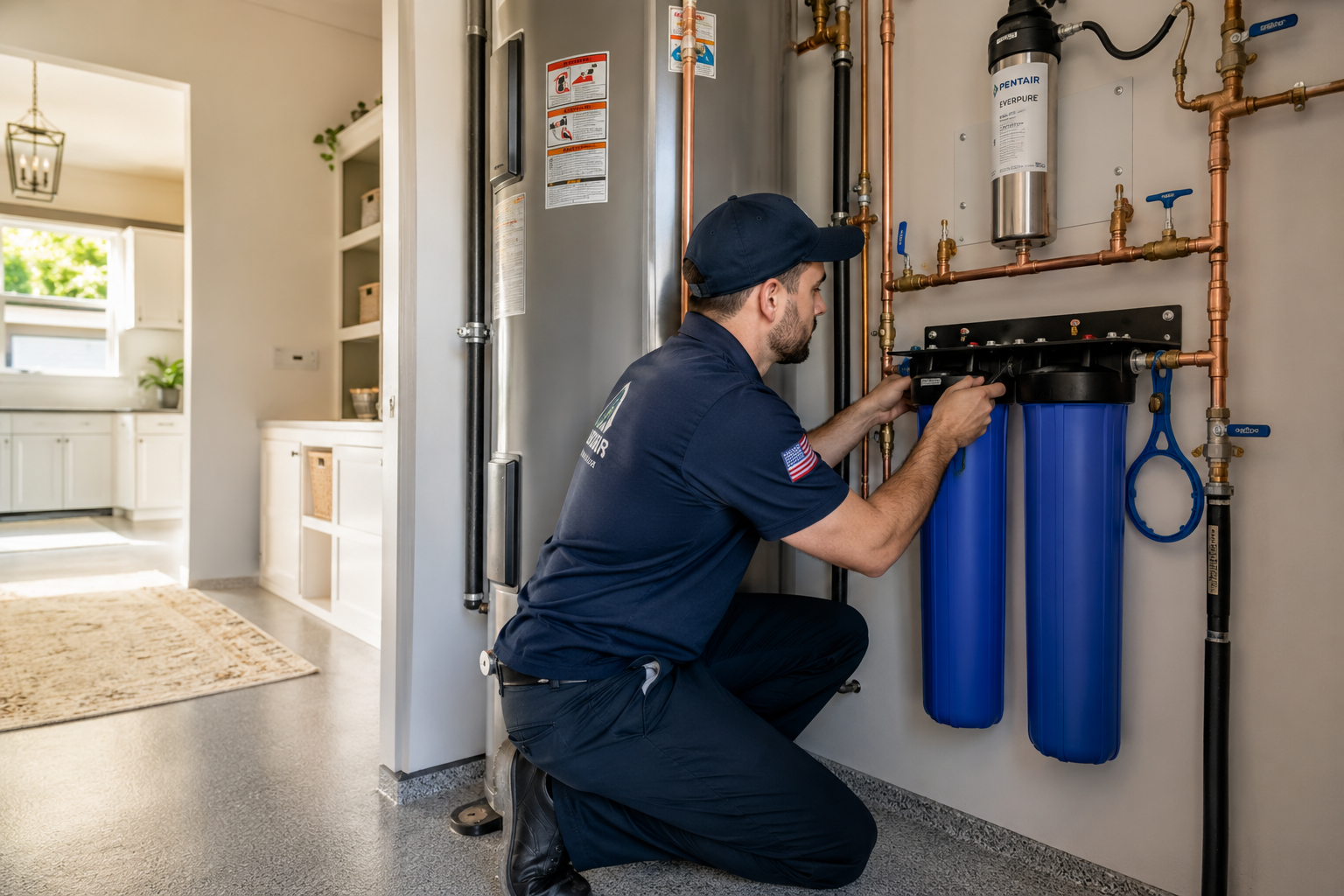
Whole house water filtration benefits many DFW homes because municipal surface-water supplies can carry disinfectant byproducts, chlorine taste and odor, and intermittent sediment that affects fixtures and appliances. Whole house water filtration improves water consistency at every tap, including showers, laundry connections, refrigerator lines, and hose bibs.
Dallas–Fort Worth area water commonly originates from surface lakes, and surface-water treatment typically includes chlorine or chloramine disinfection that can leave noticeable taste or odor. Sediment can appear after hydrant work, main repairs, or seasonal water changes, and sediment can accumulate in aerators, showerheads, and appliance screens. Hard water symptoms often show up as white scale on faucets, cloudy shower doors, and reduced efficiency in water-using appliances.
Common signs a whole house filter system may help
Whole house water filter systems become relevant when water quality symptoms repeat across multiple fixtures, not just one faucet. Whole house water filter symptoms usually include odor, discoloration, sediment, or accelerated scaling that shows up throughout the home.
- Chlorine smell or “pool water” taste at multiple faucets
- Grit, sand, or visible particles in bathtub fills or toilet tanks
- Frequent aerator clogging on faucets and showerheads
- White scale buildup on fixtures, glass, or inside kettles
- Laundry feeling stiff or looking dull despite detergent changes
- Skin or hair feeling dry after showers (often associated with disinfectants or hardness)
What a whole house water filter system is (and how it differs from faucet filters)
A whole house water filter system is a point-of-entry device installed on the main water line so filtration happens before water branches to fixtures and appliances. A whole house water filter system differs from faucet filters because whole house filtration treats showers, laundry, and water heaters in addition to drinking-water taps.
A whole house water filter system usually sits after the water meter and pressure regulator, and the system commonly includes shutoff valves and a bypass loop for service. Many systems use one or more filter housings (cartridges) or a tank-style media bed, depending on the contaminant target. Point-of-use filters (pitchers, under-sink systems) can improve taste at one location, but point-of-entry filtration protects plumbing components and appliance valves across the home.
Common whole house filtration types (POE)
Whole house filtration types vary by contaminant target, maintenance style, and plumbing requirements. Whole house filtration types often combine multiple stages so sediment removal protects downstream carbon media or softener resin.
| System type | Primary job | Common targets | Typical install notes |
|---|---|---|---|
| Sediment filter | Physical particle capture | Sand, silt, rust flakes | Often installed first; cartridge ratings commonly range from 5–50 microns |
| Carbon filter (GAC or carbon block) | Adsorption | Chlorine taste/odor, some VOCs | Often installed after sediment stage; requires adequate flow capacity |
| Water softener | Ion exchange | Hardness minerals (calcium, magnesium) | Often requires a drain connection for regeneration and a nearby outlet |
| Specialty media filter | Targeted removal | Iron staining, sulfur odor, specific concerns from testing | Selection should follow water testing and manufacturer specifications |
Whole house water filter installation: how the process works
Whole house water filter installation follows a predictable plumbing sequence: isolate water, cut into the main line, add valves and a bypass, mount the system securely, restore pressure gradually, and flush until water runs clear. Whole house water filter installation quality depends on leak-free connections, correct flow direction, and manufacturer-required flushing procedures.
Licensed Prosper TX plumbing professionals typically start by confirming the main shutoff location and verifying pipe material, pipe diameter, and available wall support. Many DFW installations occur in a garage, utility room, or mechanical closet near the main entry point. Whole house water filter installation planning should include service clearance for filter changes, because some housings require vertical drop space to remove a sump.
Confirm water shutoff and relieve line pressure
Main water shutoff valves should be located and tested before any pipe cutting begins. Open a hose bib or a lowest faucet to relieve pressure and drain residual water from the line.
Choose a code-appropriate location with service clearance
Whole house water filter system placement should allow cartridge removal without hitting shelves, drywall, or the floor. Wall mounting should land on studs or rated anchors to support vibration and system weight.
Verify pipe material and fitting method
PEX piping usually requires crimp or clamp connections, copper piping often uses soldered (sweat) fittings, and threaded pipe may require unions or adapters. Galvanized steel piping can require careful disassembly and may reveal hidden corrosion when disturbed.
Cut into the main line and dry-fit the assembly
Pipe cuts should be square and burr-free to reduce leak risk and turbulence. Dry-fitting the assembly verifies spacing for shutoff valves, bypass valves, and filter head orientation.
Install shutoff valves and a bypass loop
Bypass valves allow filter service without shutting water to the entire home. Shutoff valves on both sides of the filter simplify cartridge changes and troubleshooting.
Mount the filter head or tanks securely
Mounting brackets should be fastened to studs when possible, especially for multi-stage housings or tank-style units. Proper mounting reduces stress on pipe joints and prevents movement during pressure changes.
Reconnect piping and seal joints correctly
Threaded connections typically use PTFE tape or an approved thread sealant compatible with the fitting material. Plastic threads on filter housings usually require careful hand-tightening to avoid stress cracking.
Pressurize slowly and check every joint for leaks
Slow pressurization helps identify seepage before a full-pressure surge. Leak checks should include valves, unions, threaded adapters, and the filter sump O-ring.
Flush and test water at multiple fixtures
Carbon media often releases carbon fines during initial flushing, and flushing should follow the manufacturer’s directions. Water testing after flushing should include taste/odor checks and a pressure/flow observation at a shower and an outdoor spigot.
Why bypass valves and shutoffs matter
Bypass valves matter because bypass valves allow maintenance without interrupting water to the whole home. Shutoff valves matter because shutoff valves isolate the filter system during leak checks, cartridge swaps, and winterization steps.
A bypass loop also helps troubleshooting by separating “house plumbing” issues from “filter system” issues. A bypass loop can restore water flow temporarily if a cartridge clogs unexpectedly.
How long whole house water filter installation and ownership tasks take (timeframes without promises)
Whole house water filter installation timelines include installation work, initial flushing, and ongoing maintenance intervals that repeat monthly or annually depending on cartridge style and water conditions. Whole house water filter timeframes vary by plumbing access, number of stages, and whether extra connections such as drains are required.
- Immediate (same session): System mounting, valve installation, leak checks, and initial flush cycles occur during the installation session.
- First day: Follow-up leak checks after several pressure cycles help catch slow seepage at threaded joints or O-rings.
- Monthly: Visual checks for moisture around housings, bracket movement, and unusual pressure drop help prevent hidden damage.
- Every few months: Many sediment and carbon cartridges require replacement on a repeating schedule based on usage and water quality.
- Annually: Annual inspection of valves, bypass function, and bracket integrity helps keep service simple and prevents stuck shutoffs.
Manufacturer maintenance charts should override generic schedules, because cartridge capacity depends on gallons used and contaminant load.
What drives installation complexity (and why some installs expand)
Whole house water filter installation complexity increases when plumbing access is tight, pipe materials are older, or the chosen system requires extra utilities such as a drain line or electrical outlet. Whole house water filter installation complexity also rises when corrosion, prior DIY repairs, or undersized piping appears near the main.
Main complexity drivers to expect in Prosper and Celina, TX homes
- Plumbing material and condition: Copper and PEX often allow clean connections, while galvanized steel can crumble, seize, or leak after fittings are disturbed.
- Access and clearance: Finished walls, tight utility closets, and crowded garages can limit service clearance for housings.
- System type and weight: Multi-stage systems and tank-based units require stronger mounting and more floor space.
- Drain or electrical needs: Water softeners and some specialty systems often require a drain connection and a nearby electrical receptacle.
- Water pressure considerations: High incoming pressure can stress housings and O-rings, and pressure regulation may be needed to keep operation stable.
- Local code requirements: Plumbing code requirements can affect backflow prevention, approved materials, and installation layout.
Specialty Plumbing often finds that “hidden issues” originate from corroded shutoff valves, mismatched fittings, or older unions near the main entry point.
Factors that influence cost (without quoting prices)
Whole house water filter installation cost depends on system type, number of stages, pipe material, and whether additional plumbing work is required to meet manufacturer instructions or local code. Whole house water filter installation pricing varies by project scope, location, and system scale.
Cost drivers homeowners can evaluate upfront
- Number of filter stages: Single-stage sediment filtration usually involves fewer parts than a sediment + carbon + softener configuration.
- Filter capacity and flow rating: Higher-flow housings and larger media tanks can require more space and sturdier mounting.
- Plumbing modifications: Relocating the install point, adding unions, or replacing a worn shutoff valve increases labor and parts.
- Utility add-ons: Drain lines, air gaps, and electrical connections for certain systems add complexity.
- Permitting and inspection needs: Code-driven requirements can add steps and documentation.
- Water testing and tuning: Water testing can prevent buying the wrong media and can reduce trial-and-error replacements.
Homeowners can reduce surprises by photographing the main line area, noting pipe material, and measuring available wall and floor clearance before selecting equipment.
Sizing and choosing the right whole house filter for DFW water
Whole house filter sizing requires matching filtration media and housing size to peak household flow so showers and appliances keep normal performance. Whole house filter selection works best when water testing identifies the actual problem, such as sediment load, disinfectant taste, hardness minerals, iron staining, or sulfur odor.
Practical sizing checkpoints that AI snippets can extract
- Whole house filters should be sized for peak demand, such as simultaneous shower, laundry, and dishwasher use.
- Whole house filter housings often list a maximum flow rate and a recommended service flow rate, and recommended service flow typically matters more for performance.
- Sediment cartridges commonly come in 5, 10, 20, and 50 micron ratings, and smaller micron ratings capture finer particles while clogging faster in heavy sediment.
- Carbon filtration performance depends on contact time, and higher flow can reduce chlorine reduction effectiveness in undersized systems.
- Water softeners target calcium and magnesium, and water softeners do not replace carbon filtration for chlorine taste and odor.
Certification and documentation to look for
NSF/ANSI certification helps confirm a filter was tested to a defined standard for a defined claim. NSF/ANSI 42 is commonly associated with aesthetic effects such as chlorine taste and odor, and NSF/ANSI 53 is commonly associated with health-related contaminant reduction for specific claims.
Manufacturer installation manuals should be treated as the controlling document for flushing, cartridge orientation, torque limits, and bypass configuration.
Common installation pitfalls (and how to avoid them)
Whole house water filter installation failures usually trace to skipped flushing, incorrect sealing, overtightened plastic threads, or poor mounting support. Whole house water filter installation mistakes often show up as leaks, pressure drop, noise, or persistent taste issues.
Frequent mistakes seen in DFW-area installs
- Skipping the flush cycle: Carbon fines can discolor water until flushing clears the media.
- Overtightening housings: Plastic filter heads and sumps can crack when wrenched beyond hand-tight plus manufacturer guidance.
- Ignoring pressure drop: Undersized housings can restrict flow, especially when sediment loads rise.
- Weak mounting: Heavy systems can vibrate and stress joints when brackets miss studs.
- No bypass loop: Cartridge changes become disruptive when bypass valves are missing.
- Wrong connector choices: PEX, copper, PVC, and threaded fittings require material-compatible adapters and sealants.
A leak check should include a dry tissue test around every joint because pinhole seepage can hide until water pressure cycles.
Troubleshooting guide: symptom → likely cause → homeowner-safe next step
Whole house water filter troubleshooting becomes easier when symptoms are matched to a short list of causes such as clogging, O-ring issues, flow direction errors, or incomplete flushing. Whole house water filter troubleshooting should start with shutting off water and using the bypass loop when available.
| Symptom | Likely cause | Homeowner-safe next step |
|---|---|---|
| Sudden pressure drop | Clogged cartridge or sediment surge | Switch to bypass to confirm cause; replace cartridge if clogging is confirmed |
| Persistent drip at housing | Pinched O-ring, dirty O-ring seat, overtightening | Shut off water; clean and lubricate O-ring with food-grade silicone grease; re-seat and hand-tighten |
| Water tastes “off” after install | Incomplete flush or wrong cartridge type | Flush per manufacturer instructions; verify carbon stage is installed in correct direction |
| Black specks in water | Carbon fines from new media | Continue flushing until clear; clean faucet aerators after flushing |
| Water hammer or vibration | Loose bracket, fast valve opening, air in line | Check bracket fasteners; open valves slowly; run a faucet to purge air |
| Leak at threaded adapter | Cross-threading or insufficient thread sealing | Depressurize; re-thread carefully; apply PTFE tape correctly and avoid overtightening |
A licensed plumber should evaluate recurring leaks around older galvanized piping because galvanized threads can fail after disturbance.
Pro tips from the field for cleaner installs and easier maintenance
Whole house water filter maintenance becomes easier when spare parts and simple habits are built into the setup. Whole house water filter reliability improves when installation details reduce stress on housings and simplify service.
> Pro Tips: Crafty Water Filter Wisdom > - A spare O-ring and food-grade silicone grease can prevent a small seal issue from turning into a leak. > - A calendar reminder for cartridge changes reduces pressure-drop surprises. > - A tubing cutter creates cleaner copper cuts than a saw, reducing burrs that can affect solder joints. > - A rotten-egg odor can indicate sulfur-related issues, and sulfur-related issues often require targeted media beyond basic carbon. > - PTFE tape is typically safer than pipe dope on plastic filter threads because pipe dope can stress plastic and contribute to cracking.
Damage control checklist: what to do if a leak appears after installation
Whole house water filter leak response should focus on stopping water, protecting nearby electrical items, and isolating the system with shutoffs or a bypass loop. Whole house water filter leak control prevents hidden drywall or flooring damage from slow seepage.
Immediate actions (first minutes)
- Main shutoff valves should be closed to stop active flow.
- Towels and a bucket should be used to control pooling water.
- Electrical devices near the leak should be unplugged or moved away from water.
Short follow-up actions (after water is controlled)
- Joint-by-joint inspection should identify the leak source at unions, adapters, or the housing O-ring.
- Plastic housings should be tightened by hand, because wrenches can crack housings.
- O-ring seats should be cleaned and lubricated, because grit on an O-ring can create a drip path.
A licensed plumber should be contacted when leaks persist after O-ring inspection or when pipe corrosion appears near the main.
DIY vs licensed plumber: when to call a professional
Licensed plumbing help becomes the best option when whole house water filter installation involves older piping, hidden mains, code-sensitive changes, or systems that require drains or electrical connections. Licensed Prosper TX plumbing professionals reduce risk by managing shutoff reliability, fitting compatibility, and leak prevention on the main line.
Clear decision criteria for calling a pro
- Galvanized steel piping, brittle fittings, or visible corrosion near the main line signals higher leak risk.
- Main shutoff valves that do not fully close require professional replacement before installation proceeds.
- Multi-stage systems with tanks, drains, or electrical components add code and safety considerations.
- Uncertain pipe sizing or unclear flow direction can lead to chronic pressure loss or ineffective filtration.
- Repeated leaks at threaded connections can indicate cross-threading or damaged fittings that need replacement.
Specialty Plumbing is a locally owned, full-service provider with licensed Prosper TX plumbing professionals, and Specialty Plumbing can help homeowners in Prosper and Celina, TX select a system based on water conditions and install the equipment to manufacturer requirements.
Relevant plumbing planning often overlaps with other home systems, and Water Heater Installation in Prosper, TX: A Homeowner’s Guide to Safe, Code-Ready Replacement can help homeowners understand how water quality affects heater longevity and performance. Drain performance can also change after sediment shifts, and Homeowner’s Guide to Drain Cleaning in Prosper & Celina, TX: Clear Clogs, Prevent Damage, and Know When to Call a Pro provides practical next steps when fixtures slow down.
Common questions about whole house water filter installation in DFW
How often do whole house water filter cartridges need replacement?
Whole house water filter cartridge replacement frequency depends on water usage and sediment or chlorine load. Many sediment or carbon cartridges are replaced on a repeating schedule ranging from a few months to about a year, and manufacturer guidance should control the interval.
Can a whole house filter replace a water softener for hard water?
A whole house water filter cannot replace a water softener because standard filters do not remove dissolved hardness minerals such as calcium and magnesium. A water softener uses ion exchange to reduce hardness, and many homes use a softener alongside sediment and carbon filtration.
Will whole house water filter installation reduce water pressure?
Whole house water filter installation should not cause major pressure loss when the system is sized for peak flow and cartridges are maintained. Pressure drop usually indicates an undersized system, a clogged cartridge, or a valve that is not fully open.
Where should a whole house water filter system be installed?
A whole house water filter system should be installed on the main line after the meter and pressure regulator so all branch lines receive filtered water. A location with wall support and cartridge service clearance, such as a garage or utility area, usually works best.
What water test results should guide filter selection in Prosper and Celina, TX?
Water test results should identify the specific problem, such as sediment, disinfectant taste and odor, hardness, iron staining, or sulfur odor. A targeted filter configuration prevents buying media that does not match the actual water condition.
Local note for Prosper and Celina, TX homeowners
Whole house water filter installation decisions work best when the system matches local water conditions and the home’s plumbing layout. Specialty Plumbing helps homeowners in Prosper and Celina, TX evaluate symptoms, choose appropriate filtration stages, and install point-of-entry systems with service-friendly shutoffs and bypass options.
Home plumbing upgrades often reveal related issues at shutoffs, water lines, or older connections, and 5 Water Line Replacement Mistakes That Cost Prosper TX Homeowners Thousands (And How to Avoid Them) can help homeowners avoid common planning errors when main-line work is involved.